What the Autonomous Loop actually does
Each cycle, the engine makes and executes the four decisions a marketing manager would — and shows its work.
What to say today
The planner reads live signals — festivals, your brand mentions, competitor activity, your own top performers — and proposes topics tied to your growth goal. The calendar never sits empty.
Write it, design it, in every language
The engine drafts multiple candidates and runs them past an AI critic before keeping the best. Copy is native per language — 40 supported — and creative is built as editable layers, never flat images.
Score it before anyone sees it
Each autopilot draft is graded by the copy scorer — length fit for the channel, hook, call to action, brand fit, hashtag and emoji discipline, readability, minus penalties for shouting and overclaiming — and then read once more by the model, which predicts its likely reach and engagement. Drafts that come back weak get regenerated automatically. What reaches your queue has already cleared a bar.
Your call, wherever you are
Approve, edit, or reject from the console — or straight from Slack and Microsoft Teams buttons. Edits save back into the draft; rejects teach the engine what not to bring you again.
At your audience's real peak
Best-time scheduling learns a weekday-by-hour heatmap per channel from your own results, places approved posts into peak slots, and revalidates them as new data lands. Each one waits in its slot one tap from posted, and goes out on its own from the day direct publishing is switched on for that channel.
Every result changes the next decision
Impressions, clicks, and lead captures flow back automatically. A bandit model shifts future drafts toward the tones, hooks, and formats that win for you — per language, per channel. Weights are visible, not a black box.
The step in the loop nobody else has: it marks its own work.
Between writing and your approval queue there is a step most tools skip entirely. Every post is scored against your brand and against your last month of posts before you ever see it, and the ones that do not hold up are rewritten rather than sent.
By the time a post reaches you it has already failed once and been fixed. That is why the queue stays short enough to actually read.
How is this different from an AI writing assistant?
An AI writer hands you a draft when you ask. The Autonomous Loop runs without being asked — it notices Diwali is in nine days, drafts a two-language campaign across Instagram and WhatsApp, scores it, books the best slots, and queues it for one-tap approval.
Waits for a prompt → returns text.
Watches signals → returns finished, scheduled, pre-tested campaigns.
What stays under your control?
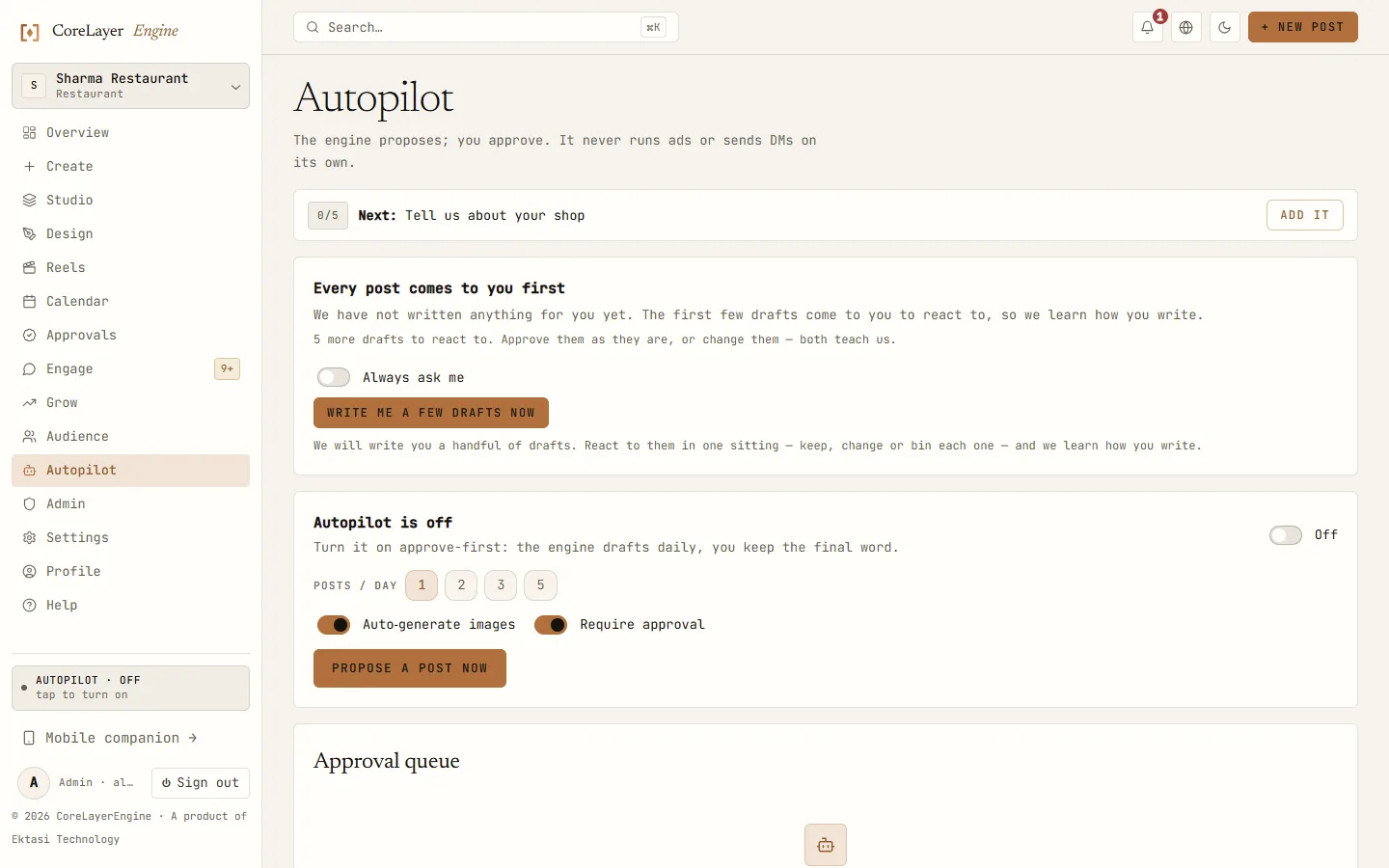
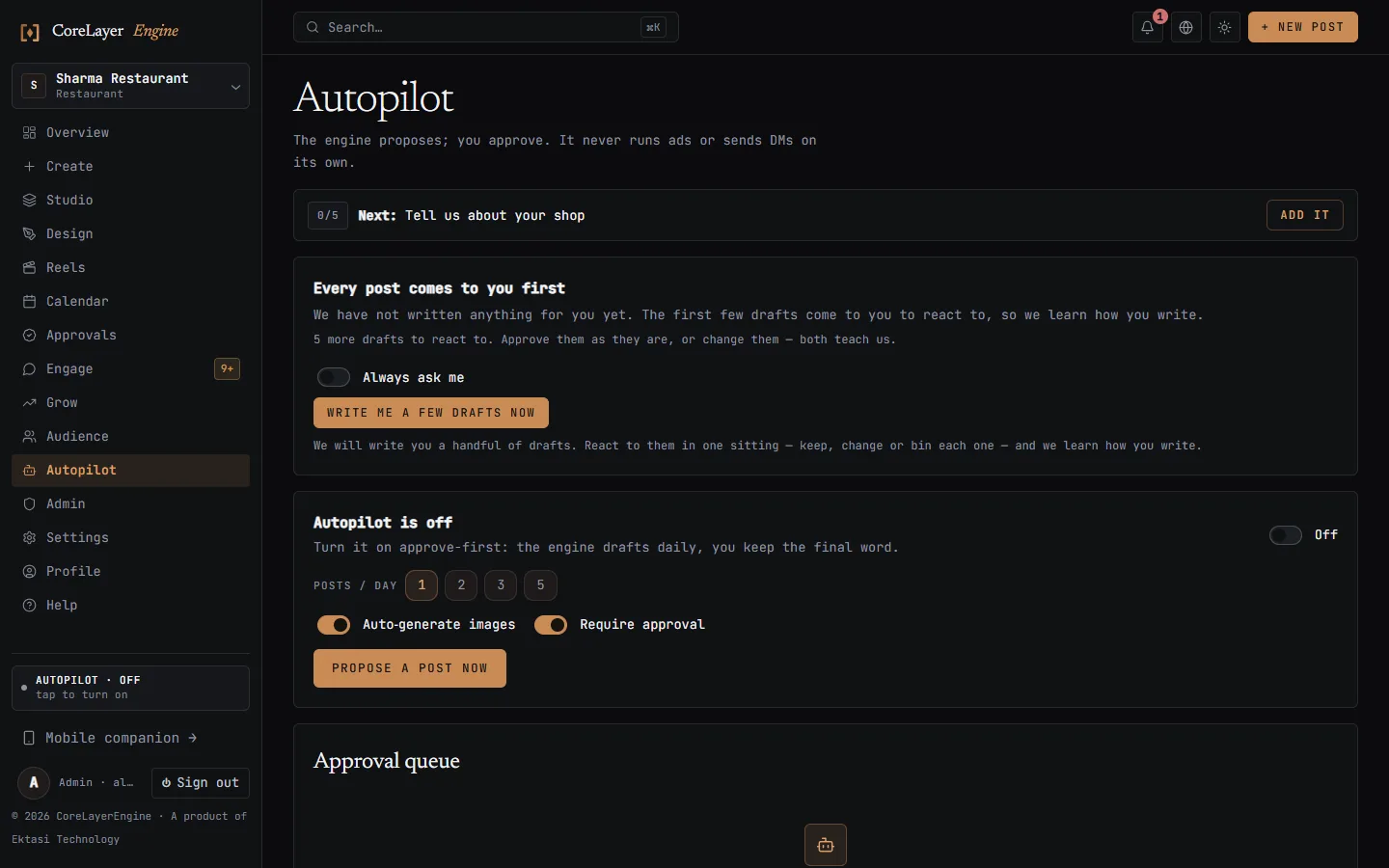
Everything that matters. Autopilot has three modes — off, approve-first (default), and full-auto within guardrails. Daily generation caps prevent runaway volume, and proposals expire if you ignore them rather than piling up.
The engine never buys ads and never sends direct messages. Public-figure accounts never leave approve-first — full-auto is not available to them by policy.
What results feed the learning loop?
- ✓Channel metrics pulled automatically — impressions, engagement
- ✓Tracked-link clicks on every published post
- ✓Captured leads attributed to the exact post and channel — Audience & CRM
- ✓Comment sentiment on your own posts — Social Listening
Every CoreLayerEngine post carries a tracked link, so learning optimizes for clicks and leads — not vanity impressions.
Questions about the loop
What is an autonomous social media loop?
An autonomous loop is a repeating AI process that ideates content from live signals, generates and pre-tests drafts, schedules approved posts at learned best times, and feeds results back into the next cycle. Unlike a scheduling tool, no step waits for a human prompt — only for human approval.
How does CoreLayerEngine decide what to post?
The planner combines your growth goal with live inputs: upcoming festivals and events, your brand mentions, competitor benchmarks, and your historical top performers. It proposes topics, drafts multiple candidates, and an AI critic selects the strongest before anything reaches your approval queue.
How does best-time scheduling work?
The engine builds a weekday-by-hour engagement heatmap per channel from your own audience's behavior, schedules approved posts into peak slots, and revalidates slots as new outcomes arrive. It's learned from your data — not a generic "7 PM" rule.
Can I edit what the autopilot drafts?
Yes, everything. Copy is editable inline, and creative is built as layered, editable designs — change one headline, recolor a background, or ask AI to rewrite a single line. Your edits are saved to the draft and inform future generations.
What happens if a draft performs badly?
The result still helps. Underperforming tones, hooks, and formats lose weight in the bandit model, so the engine drafts less of what didn't work and more of what did. Learning is per-language and per-channel, and you can view the learned weights anytime.