Autonomous social media management is software that makes the everyday marketing decisions for you — what to post, how to write and design it, when to publish it, and what outcome it should chase — and then publishes inside approval rules you set. A scheduler waits for your content. An autonomous engine produces it, proposes it, and learns from the result.
The phrase gets used loosely. Almost every social tool now has an "AI" button, and most of them mean "a text box that writes a caption." That is useful, and it is not autonomy. The difference is not how clever the writing is; it is how many decisions the software is willing to own.
The four eras, briefly
Social tooling has moved through four recognisable generations, and most teams are running a mix of all four right now.
- The scheduler. You write the post, you pick the time, the tool remembers to publish it. The value is reliability. The work is all yours.
- The assistant. A caption generator sits next to the composer. It shortens the blank-page problem. You still decide what to write about, what it should look like, and when it should go out.
- The agent. You give an instruction — "write me five posts about the new menu" — and it executes. Better, but you are still the one who noticed the new menu, chose five, and knew that this week was the week.
- The autonomous engine. Nothing is waiting on your instruction. The system watches your calendar, your mentions, your competitors and your own past results, decides what is worth posting, produces it, predicts how it will do, and puts it in a queue for you to approve.
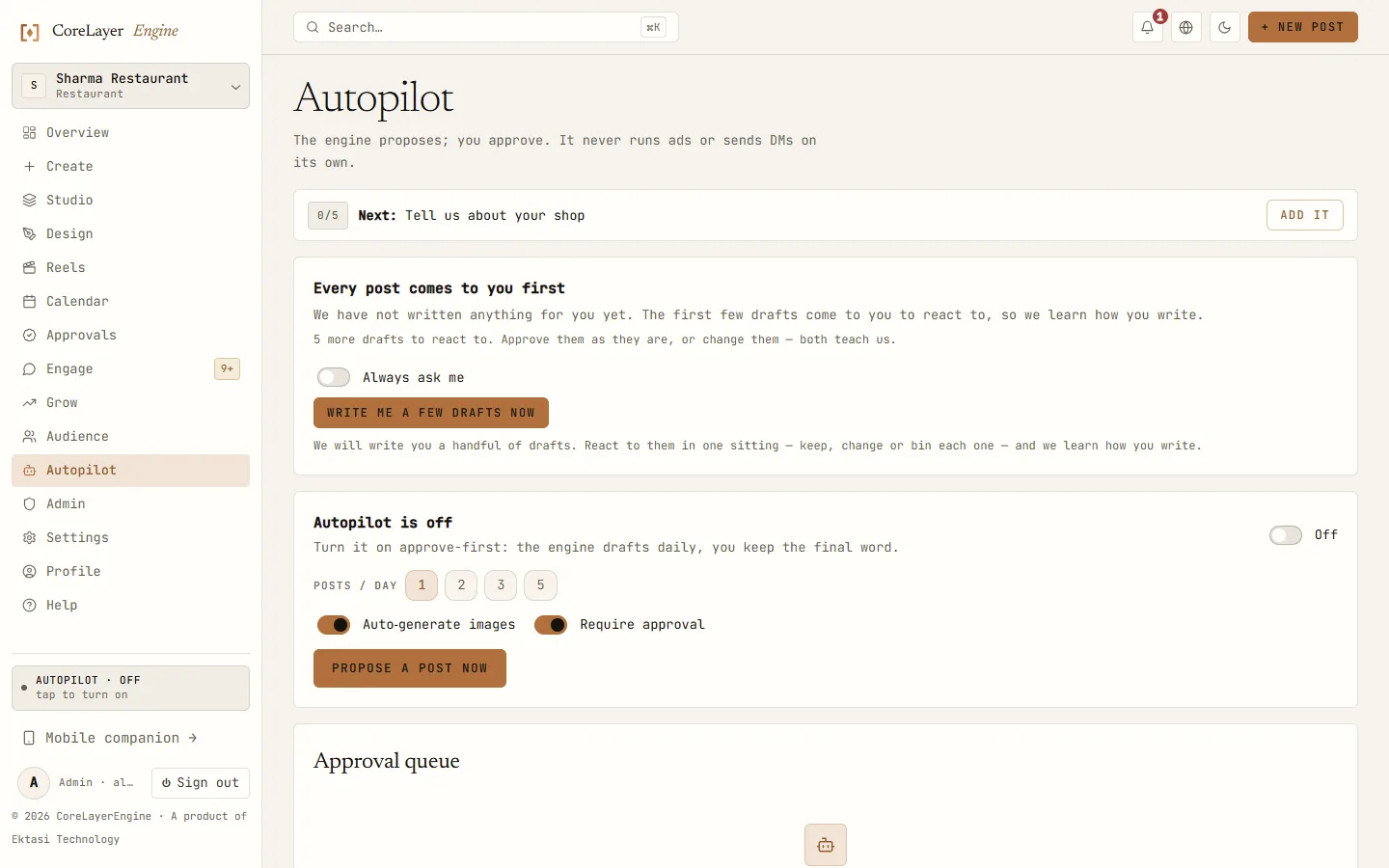
The tell is what happens when you go quiet for two weeks. A scheduler publishes whatever you loaded before you left, then stops. An assistant sits idle. An autonomous engine keeps proposing — and, if you have approved that, keeps publishing.
The four decisions
"Autonomous" is only meaningful if you can name which decisions the software is actually making. There are four, and a tool should be judged on each separately.
1. Topic — what is worth saying this week
The hardest one, and the one most tools skip. Deciding a topic means combining things the software has to actually know: what is coming up on the calendar (a festival, a season, a local event), what people are already saying about you, what similar businesses are posting, and which of your own past posts earned something. A tool that asks you for the topic has not made this decision. It has just made the typing faster.
2. Craft — the copy and the design
Writing in your voice, in the languages your audience actually reads, and producing something to look at. The bar here has risen fast, but two details separate real craft from filler: whether the copy is generated natively per language rather than translated, and whether the design comes back as an editable layered document or a flat image you cannot fix.
3. Timing — when to publish
Not "best times to post in 2026" from a blog post, but a model learned from your own account's results, per channel, because your Instagram audience and your LinkedIn audience are not the same people and do not keep the same hours.
4. Objective — what the post is for
Every post should map to a stated goal, and the results should feed back. If posts with a question in the first line consistently earn clicks for you and posts with a discount do not, the engine should shift its output without you writing that rule down. That is the loop that makes month six better than month one.
What makes autonomy safe
Autonomy without governance is just an unattended publishing bot, and that is a bad idea for anyone with a reputation. The governance layer is not a compliance checkbox bolted on afterwards; it is the thing that makes the autonomy usable at all.
Four mechanisms do most of the work:
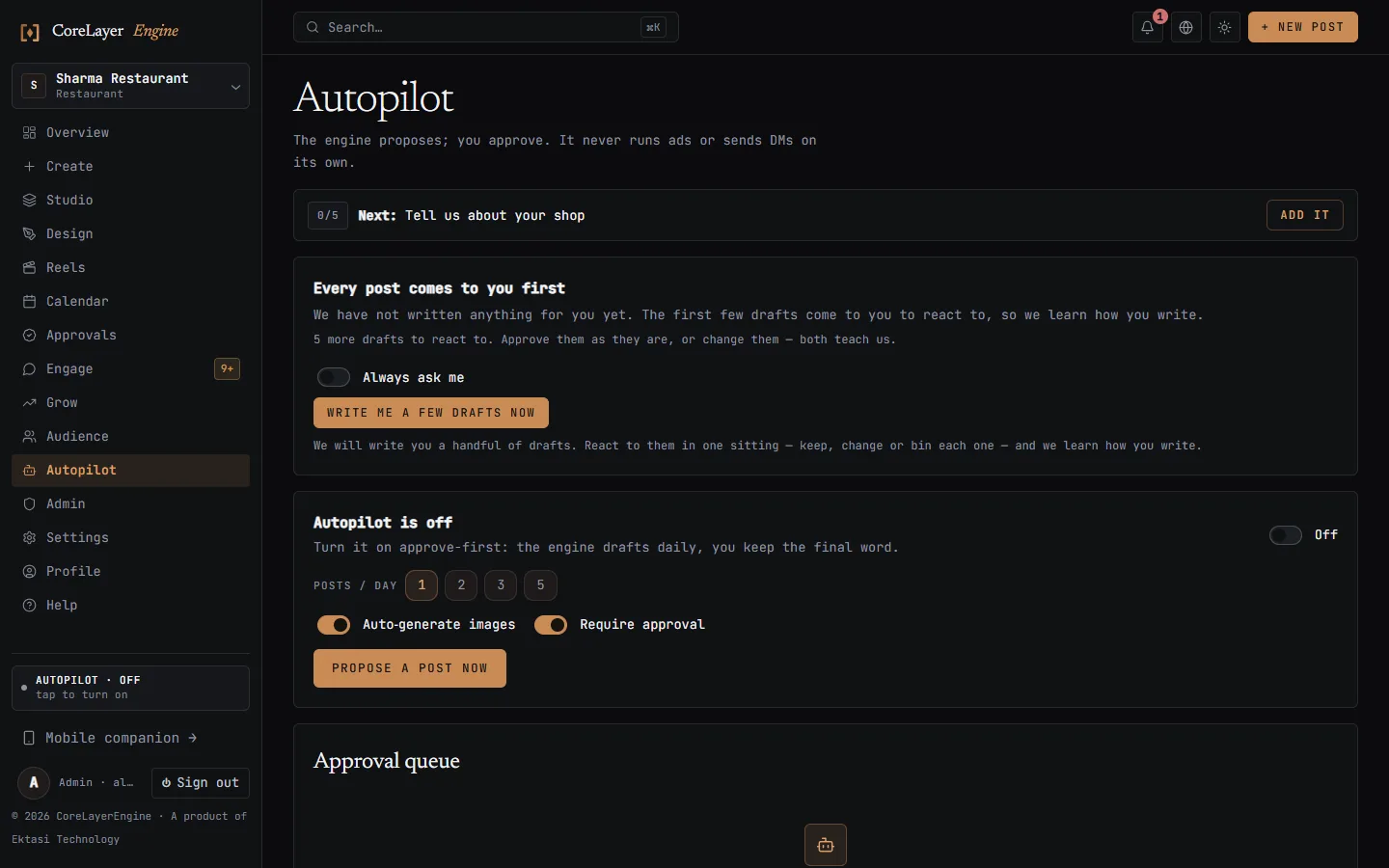
- Approval-first by default. The engine proposes; a human decides. Turning approval off should be a deliberate act, not the default state.
- Named approvers and the two-person rule. For anyone whose words carry weight — a public figure, a regulated business, an agency posting on a client's behalf — the person who edited a post should not also be the person who publishes it.
- Crisis mode. One control that halts everything scheduled, immediately, because the worst possible moment for a cheerful automated post is the hour something has gone wrong.
- A tamper-evident audit trail. Who approved what, when, and what the text said at that moment. If you cannot reconstruct that later, you cannot defend a decision later.
This is also where governance stops being a feature list and becomes an operating model: the engine is fast, the human is accountable, and the record shows which was which.
What autonomy should never touch
A vendor that will not name its limits has not thought about them. Ours are deliberate and we would rather print them than be asked:
- Never spends your ad budget. Organic publishing and paid media are different risk profiles. An engine that can quietly spend money is an engine that can quietly lose money.
- Never sends direct messages. A public reply is visible and correctable. An automated DM is neither, and it is how brands end up in screenshots.
- Never publishes unattended for a public figure. Where a workspace is approve-first, no automation — and no API key — can substitute for that person.
Seven questions to test any "autonomous" claim
Take these to any vendor demo, including ours. They are ordered so the first three eliminate most of the field.
- If I add nothing for thirty days, what appears in my queue? If the answer is "nothing," it is a scheduler.
- Where did this topic come from? Ask them to trace one proposed post back to the signal that caused it.
- Show me the same idea in two languages. If the second is a translation of the first, it will read like one.
- What did it learn from last month? Ask what changed in the output as a result — not what the dashboard reports.
- What happens when I edit a draft and approve it myself? A serious governance model has an opinion about this.
- Can I stop everything in one click? And does that include posts already queued at the platform?
- What will it never do? If there is no answer, the limits have not been designed.
Where to start
You do not have to adopt autonomy all at once, and you should not. A sensible first month looks like this: connect two channels rather than ten, leave approval on, and let the engine fill the queue for two weeks while you approve or reject everything. The rejections are the useful part — they are how the system learns your taste, and how you learn whether the topic decisions are any good.
After a fortnight you will know the only thing that matters: whether the queue is full of posts you would have been happy to write yourself. If it is, widen the channel list — a single approved idea can become a feed post, a professional-register version for LinkedIn, and a vertical video, each written for its own audience. If it is not, the topic decision is where to look first, because everything downstream is built on it.
CoreLayerEngine's Forever Free plan exists for exactly this test: five posts a month, no card, no expiry. Two weeks of approvals will tell you more than any feature comparison.