Social media attribution is the chain that connects a specific post to a specific customer: post → tracked link → landing page → captured contact → your CRM. Without that chain you have engagement counts, which tell you that something happened but never which thing worked. With it, you can name the post that produced last Tuesday's booking.
Most small businesses never build the chain, and the reason is reasonable: it sounds like a data project. It is not. It is four links, and the whole thing can be standing before lunch.
Why likes lie
Engagement metrics are not fake, they are just measuring a different thing than you are. Three specific problems:
- They reward the wrong post. The funny one gets the likes. The boring one with the price and the phone number gets the customer. Optimise on engagement and you will systematically produce more of the first.
- They are not comparable across channels. A save on one network, a share on another and a comment on a third are different behaviours with different intent. Adding them into one "engagement" number produces a figure that cannot be acted on.
- They stop at the platform boundary. The interesting part of your funnel happens after someone leaves the app, and engagement metrics cannot see any of it.
None of this means engagement is useless. It is a fine early signal for whether a hook works. It is a terrible basis for deciding what to post next quarter.
The attribution chain, link by link
Link 1 — the tracked link
Every post that asks for an action carries a link unique to that post and that channel. Not one link for your whole account: one per post, per channel. That uniqueness is the entire mechanism. When someone clicks, you know which post and which network sent them, because there is only one way they could have arrived at that URL.
Link 2 — the landing page
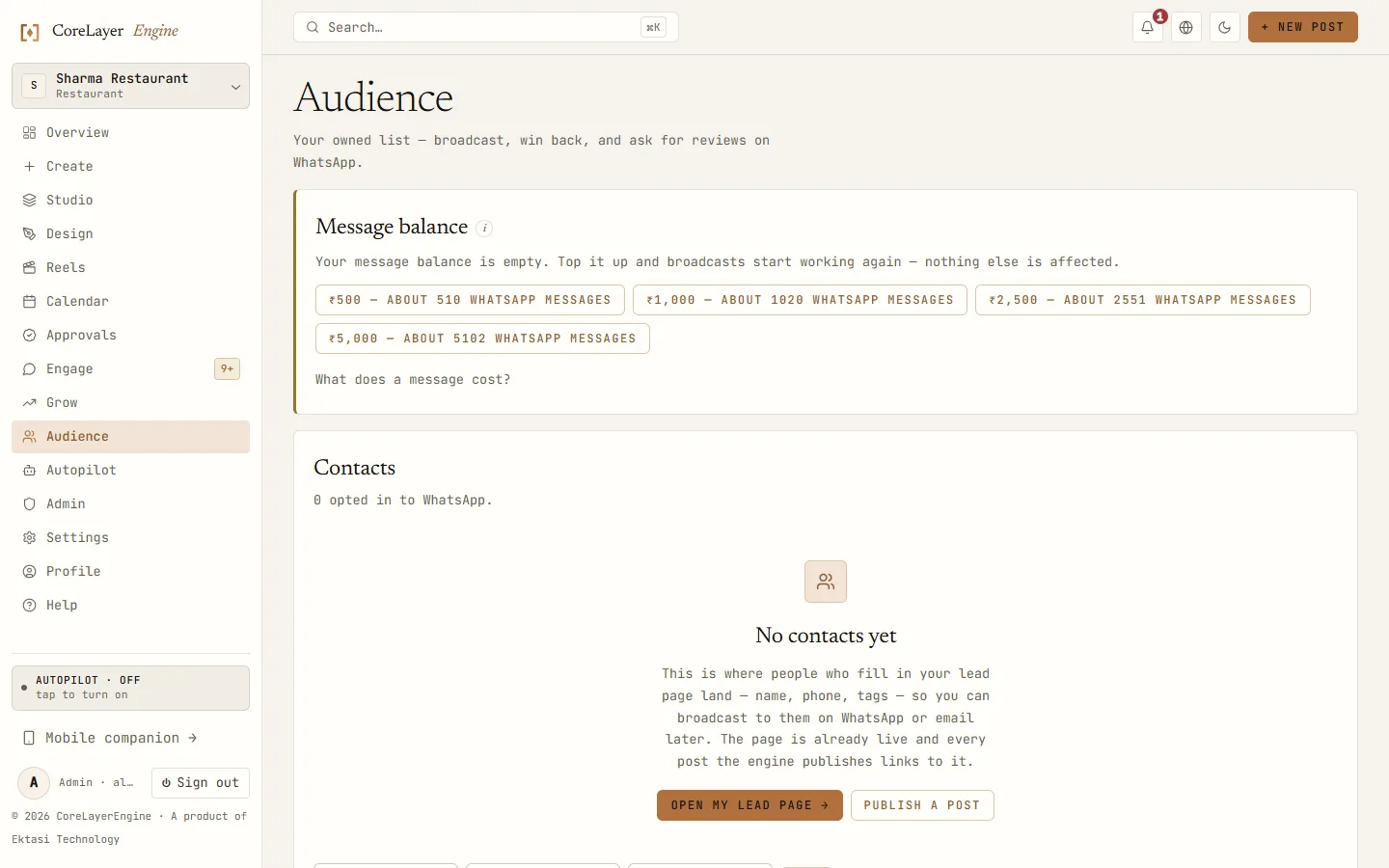
The link goes somewhere designed to capture, not to your homepage. A homepage asks the visitor to work out what to do next, and most will not. A landing page asks one question — name and phone, or name and email — and carries the campaign identifier through from the link.
Link 3 — the captured contact
The form submission becomes a contact record that keeps the source: which post, which channel, what date, and what the person consented to. That consent record matters as much as the contact. A phone number you cannot lawfully message is not a lead.
Link 4 — your CRM
The contact leaves the marketing tool and lands wherever you actually run your business — a CRM, a spreadsheet, a WhatsApp list, a booking system. A webhook does this the moment the lead is captured, so the person who calls them back is not waiting on an export.
Set it up in fifteen minutes
Concretely, in the order that works:
- Turn on your lead page and write one question. Whatever you would ask a customer who walked in. Resist adding fields; every extra one costs you submissions.
- Switch on tracked links for published posts. In CoreLayerEngine this is one setting and it appends a per-post, per-channel link automatically, so you are not maintaining a spreadsheet of URLs.
- Point a webhook at wherever you work. If you have a CRM, use its inbound webhook. If you do not, a spreadsheet or a chat channel is a perfectly respectable destination — the point is that a human sees the lead within minutes.
- Publish three posts with a real reason to click. An offer, a booking, a menu, a price list. "Follow us for more" is not a reason to click and will teach you nothing.
- Wait two weeks and do nothing. The hardest step. Fewer than a couple of weeks of data and you will read noise as a trend.
Reading the report without a data team
You are looking for three things, in this order.
Which posts produced leads at all. Not the most clicks — the most captured contacts. Clicks measure a headline; captures measure whether the offer was real. A post with fewer clicks and more captures is the better post, every time.
Which channel produced them. The same offer on two networks will not perform the same, and the gap is usually larger than people expect. This is the number that should change how you spend your time.
What the winners had in common. Was it a price? A deadline? A specific dish or service rather than a category? Two or three winning posts is enough to see a pattern, and the pattern is worth more than the individual posts.
If you only ever look at one number, look at leads per channel per month. It is the only figure that survives contact with your bank account.
When a channel attributes zero: kill or fix
Eventually a channel will show a month of posts and no captured leads. Before you abandon it, work through this in order — the first three are mechanical faults, and they are far more common than the channel being genuinely wrong for you.
- Was there a link at all? Some networks strip or de-emphasise links in captions. If the link lived somewhere unclickable, you measured nothing.
- Was there a reason to click? Read the last ten posts as a stranger. If none of them asked for anything, the channel is not failing — the posts are.
- Did the page load properly on a phone? Open your own landing page on mobile data, not office wifi. This finds more problems than any analytics screen.
- Is this channel doing a different job? Some networks are discovery, not conversion — people find you there and convert somewhere else entirely. If walk-ins mention it, it is working even if attribution is silent.
- Only now: reduce or stop. Halve the volume for a month rather than cutting to zero. If nothing downstream changes, you have your answer honestly.
Attribution is not there to prove marketing works. It is there to tell you which quarter of it does, so the other three quarters can stop. That is a smaller and much more useful claim, and it is the one this chain can actually support — first-touch attribution tells you what started a relationship, not everything that shaped it. Someone who saw four posts and clicked the fifth will be credited to the fifth. Read the pattern, not the individual row.
In CoreLayerEngine, tracked links, the hosted lead page and signed outbound webhooks are on every plan including the Forever Free one. Contact capture with consent records and the CRM that keeps the source against every contact are the Leads add-on, priced separately at ₹4,999 a month.