To be recommended by an AI assistant you need to be findable, unambiguous and consistent: retrievable content the assistant can reach, a clearly defined entity it can identify as you, and the same facts stated the same way everywhere it looks. Nobody outside those companies knows the ranking rules, and anyone who tells you they do is guessing — but the retrieval layer is public, and that is what you can work on.
Start with the honest caveat, because it shapes everything after it. These systems change often, they differ from each other, and the mechanism is not documented the way search ranking factors were. What follows is not a growth hack. It is the same discipline that made businesses findable in search — accurate, structured, consistent information — applied to a reader that is a machine reading on someone's behalf.
How assistants pick businesses to mention
Stripped to essentials, three things happen, and each one is a place you can be excluded.
Retrieval
The assistant fetches candidate material — from a search index, from a live fetch of pages, or from what the model absorbed in training. If your information exists only inside a social app, a PDF, an image or a JavaScript view that renders nothing without a browser, it may never enter this stage at all.
Entity resolution
The assistant decides who you are and whether you match the question. This is where most small businesses lose. If your name, address and category are stated three different ways across four places, you look like three weak entities instead of one confident one.
Synthesis
The assistant writes an answer and picks who to name. Specific, checkable, self-contained facts survive this step. Marketing language does not — "the leading provider of premium solutions" contains nothing an assistant can safely repeat, so it repeats someone else.
The four surfaces worth publishing
These are the artefacts that make you retrievable and unambiguous. None requires a developer beyond the first one, and all four are things you control.
1. A plain-text summary at /llms.txt
A markdown file at the root of your domain describing what you do, who you serve, what you sell and where to find more. It is a convention rather than a standard, and support varies — treat it as cheap insurance, not a silver bullet. The discipline of writing it is worth the hour regardless: if you cannot describe your business in 300 plain words, no assistant will manage it either.
2. Structured data on the pages that matter
Schema.org JSON-LD for your organisation, your locations, your products or services and your FAQs. This is the least speculative item on the list because it is machine-readable by design and already consumed by search. Get Organization, LocalBusiness and FAQPage right before anything else.
3. A machine-readable product or service feed
A JSON file listing what you actually sell, with names, descriptions, prices and availability. Assistants asked comparative questions — "who does X in this area, and roughly what does it cost" — need something concrete to compare. A page of prose is not that.
4. Consistent entity copy everywhere
The same business name, the same address format, the same one-sentence description on your site, your social profiles, your listings and your directory entries. This is the least glamorous item and the one with the most impact, because inconsistency directly damages entity resolution.
A walkthrough for any business
You can do all of this yourself, with or without our product.
- Write the definitional sentence. One sentence: what you do, for whom, where. Plain, checkable, no adjectives you would not defend. This sentence is now the source of truth for every other surface.
- Fix the inconsistencies first. Open your website, your social profiles and your map listing side by side. Make the name, address and description identical. Do this before anything technical; it is free and it is the highest-value step.
- Add or correct your structured data. Organisation and location schema on the homepage, FAQ schema on any page that answers questions. Validate it — invalid JSON-LD is ignored entirely, which is the same as not having it.
- Write an FAQ page that answers real questions. Not "why choose us." Actual questions with 40-to-60-word direct answers, the answer in the first sentence. This is the format assistants quote most readily, and it doubles as useful content for humans.
- Publish /llms.txt. Your definitional sentence, what you sell, who you serve, your key pages, contact details. Keep it under a page and keep it current.
- Publish a feed if you have a catalogue. Even a simple JSON list of services and prices is better than a menu image, which is invisible to everything.
- Re-check quarterly. Ask the assistants a question a customer would ask and see whether you appear. Write down what you see, with the date. That record is your only real measurement.
How CoreLayerEngine automates this
One clearly-marked product section, because the walkthrough above stands on its own.
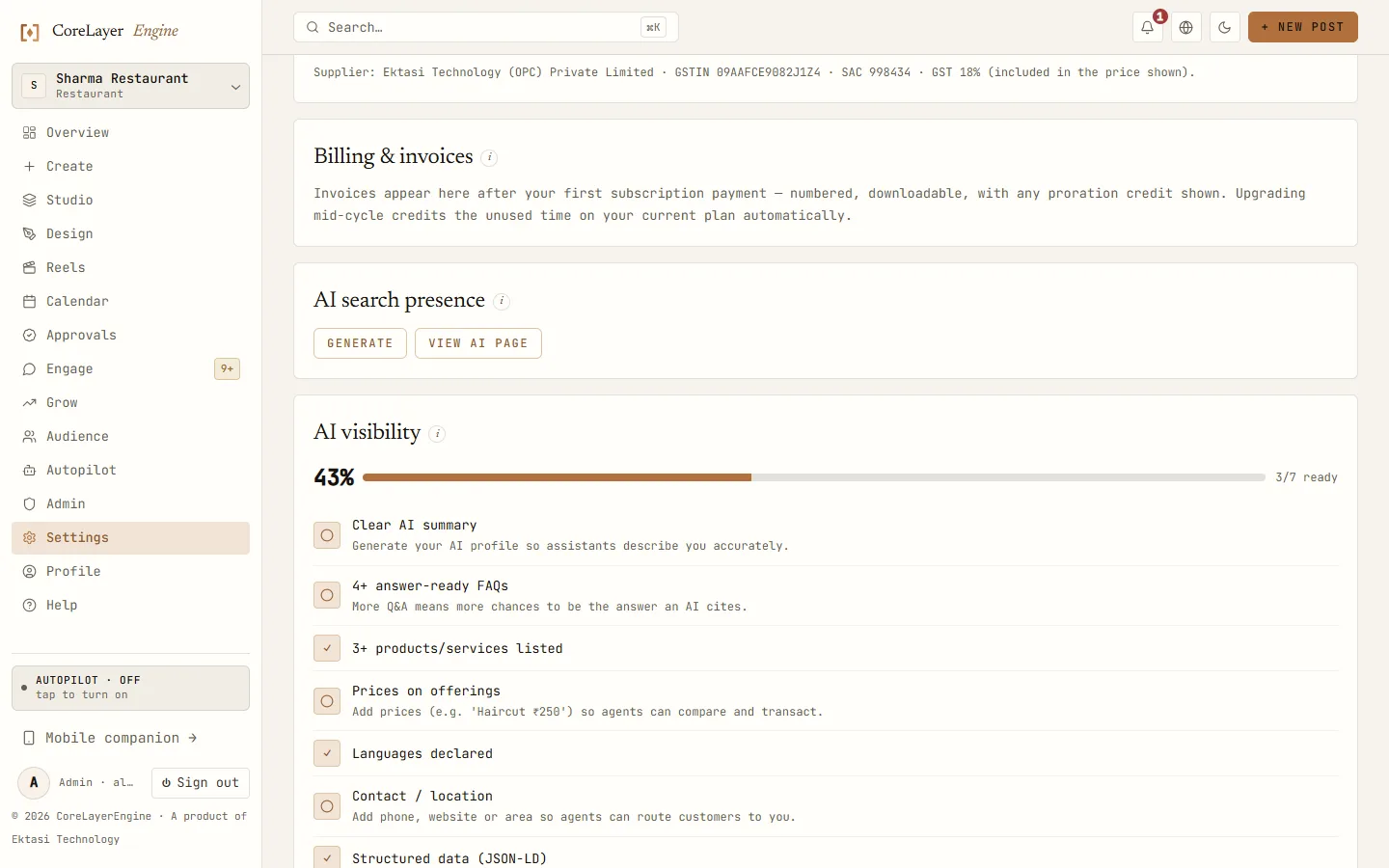
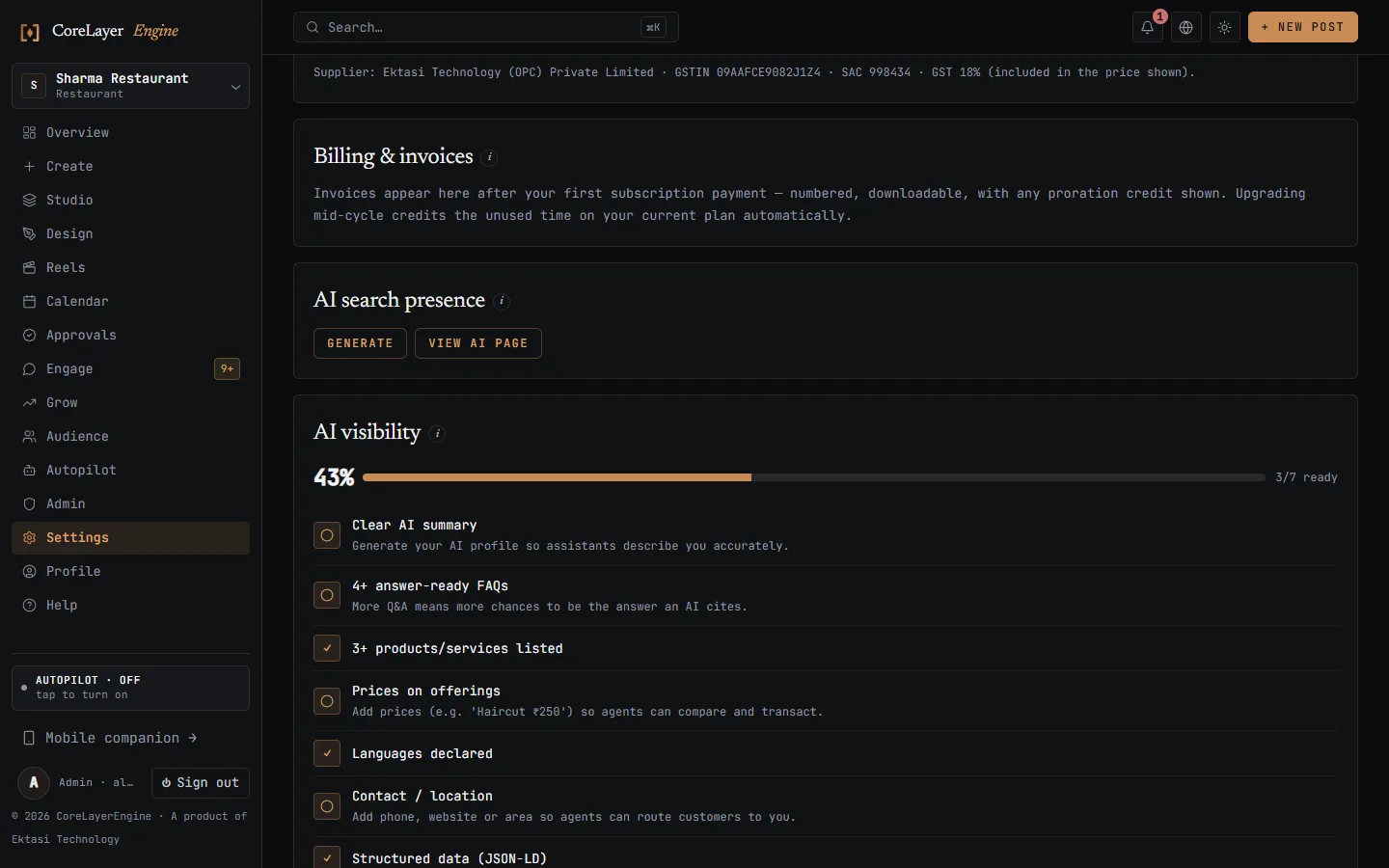
CoreLayerEngine publishes three of the four surfaces per business automatically: a machine-readable profile, a product feed, and an llms.txt — each at a stable URL on the app domain, regenerated when your details change. It also scores your readiness against the checklist above and proposes rewrites of your public description, which you approve like any other content. The fourth surface, consistency across your own listings, is still yours: nothing can rename your business on a map for you.
What it does not do is promise placement in any assistant's answer. Nobody can promise that, and a vendor who does is telling you something about themselves. What you can control is being retrievable, unambiguous and consistent — and that is the whole of the work. Our AI visibility page has the detail.
Measuring it honestly
There is no rank tracker for this, and the tools that claim to be one are sampling a system that varies by user, by session and by model version. Two things are worth doing instead.
Ask, and keep a record. Once a quarter, ask three or four assistants the questions your customers would ask. Screenshot the answers with the date. Over a year that record shows a direction, which is more than a single reading ever will.
Watch referrals. Assistant-driven visits are starting to show up in analytics referrers. The volume is small and the attribution is imperfect, but a real visitor is a stronger signal than any inferred score.
This post tries to follow its own advice: a definitional first sentence, question-shaped headings, direct answers, no unverifiable statistics. If you are also deciding which tool to run all this through, our honest guide to AI social media tools covers that separately, and the Forever Free plan includes the AI-visibility profile.